What is the adult’s role within a play-based program? Within a play-based program
the adults role is not to dominate or dictate but to guide, evoke and extend.
By continually evaluating the children’s play you will be able to discover what
they are learning and from there help shape and extend their learning. This may
include asking questions to expand the play, participating, interacting, consolidating,
observing and monitoring the play. With this being said children are focused,
learn to think and can follow through with their discussions, ideas and
negotiations. “Children develop inner
motivation and readily take responsibility for their own learning, so are
equipped for higher learning and life skills. The most important play for young
children is play with parents-make sure you make some time for play every day.” Source: http://www.latrobe.vic.gov.au/WebFiles/Council%20Services/Family%20and%20Child/Learning%20is%20Child%27s%20Play.pdf
This information was quoted directly from Suite101: Kids Play to Learn: Parents and teachers can help kids learn by helping
kids play http://primaryschool.suite101.com/article.cfm/kids_play_to_learn#ixzz0g6F5UfeA
• Children may play on their own in solitary play; alongside someone else but independently in parallel play or with other children in cooperative play • Play may be structured, where someone else makes the rules and decisions • Play may be unstructured, where the child is self-directed or takes all the initiative. We can support children’s play by • allowing for extended periods of time for children to remain in ‘the flow’ of their play • providing resources such as safe household items and materials • making enough space to focus on the play activity • catering for choices of activity, materials and equipment • role-modeling to encourage and extend ideas • challenging them with more complex thinking, novel ideas or experiences |
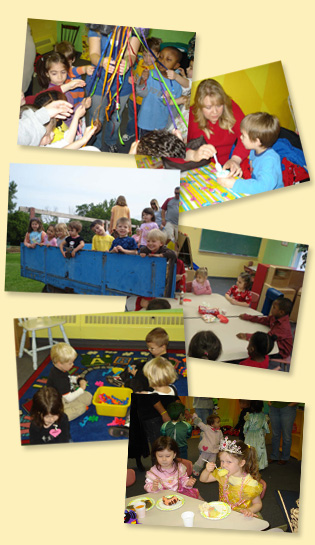 Pictures from: http://www.academicpathwayspreschool.com/ (Approved to post these pictures) |
